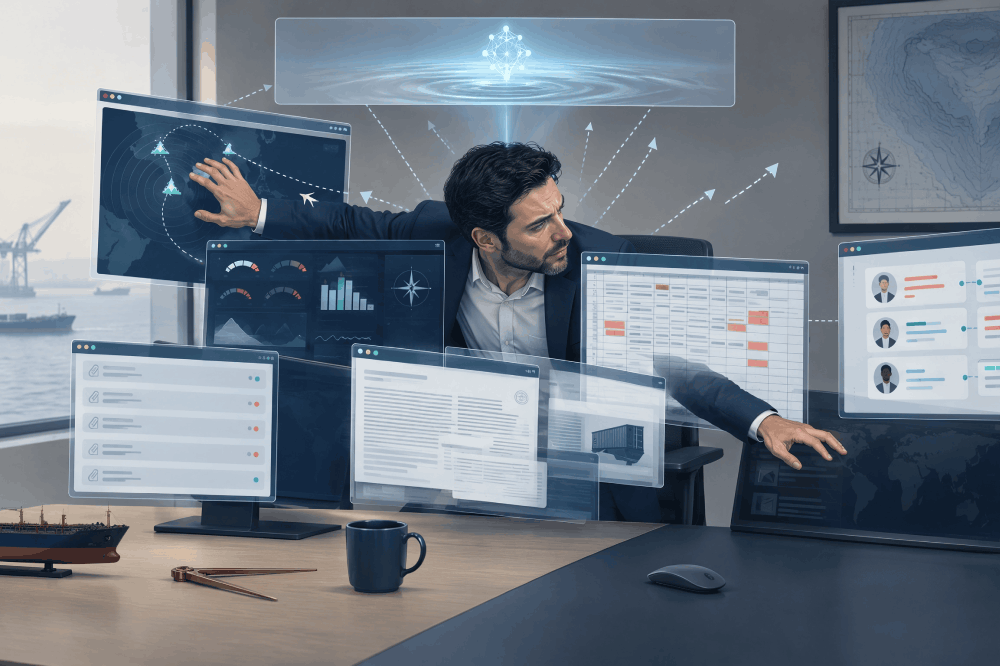
The industry has spent years adding more software to solve individual problems, and now we are adding AI on top of the fragmentation. But AI only becomes truly valuable when the underlying data, workflows, industry, and business context are connected.
For years, digitalization has promised to make our working lives easier. Yet for many people working in shipping, the reality looks rather different.
Your vessel information is in one system. AIS data is somewhere else. Emails sit in Outlook. Documents are stored on SharePoint, local drives, or both. Commercial information may live in spreadsheets and CRM systems. And your colleagues often have important information you don't.
So throughout the day, you search. You switch applications. You copy and paste. You check another source. You ask a colleague. Then you go back to where you started.
And now we are adding another layer to this increasingly complicated technology stack:
The AI.
AI assistants and agents promise to automate repetitive work, find information, analyze data, and help us make better decisions. But there is an important question we should probably ask first:
If your people struggle to find the right information across all your systems, how will your AI agents find it?
The hidden cost of jumping between applications
The productivity loss associated with fragmented software isn't just a feeling.
Research published by Harvard Business Review, based on 137 users across 20 teams at three Fortune 500 companies, found that workers toggled between applications and websites roughly 1,200 times per day.
The researchers estimated that workers spent just under four hours per week reorienting themselves after switching, equivalent to roughly 9% of their annual working time.
Another study conducted by Ellis Idea Lab together with Qatalog found that employees reported spending 59 minutes every working day looking for information across different applications.
The same research found:
- 43% said they spend too much time switching between different work software.
- 45% said the back-and-forth makes them less productive.
- 48% said they make mistakes because they cannot keep track of what is happening across their employer's different digital tools.
- 44% said siloed digital tools make it difficult to know whether work is being duplicated.
So the problem isn't simply that we have too much information. The information is fragmented.
Shipping is an information-intensive business, and shipping makes fragmented information an even bigger problem
Because the “shipping world” changes continuously. Vessels move. ETAs change. Weather changes. Bunker prices change. Port situations change. Sanctions and geopolitical developments change. New emails arrive. Customers call. Colleagues add information.
A commercial decision rarely depends on one isolated data point. It depends on a thoroughly understood context.
Where is the vessel now? Why is she there? Where has she traded before? Where is she heading? What do we know about the ports that she visits frequently? Who do we know? Is she approved? What have we previously discussed with this customer? What documents do we have? Where is the market going? What does the market look like in two weeks' time? What does my colleague know that I don't?
The individual pieces of information can all be correct. The challenge is bringing the relevant pieces of data and information together in a team quickly enough to discuss the assumptions and make good decisions.
AI doesn't magically remove fragmentation.
Quite the opposite; the challenge becomes even more important as companies start introducing AI.
There is enormous excitement around AI agents, and rightly so. AI offers the potential to automate repetitive work, analyze huge amounts of information, and support decisions in ways traditional software cannot. But AI isn't magic.
Giving an AI agent access to more data does not automatically mean it will make better decisions.
Imagine an agent looking at a vessel.
- The AIS position may be correct.
- The vessel's technical specifications may be correct.
- The ownership information may be correct.
- The emails containing information about the vessel may be correct.
- The document containing information about the vessel may be correct.
But what connects these data?
That is where an understanding of maritime and business context comes in. AI only becomes truly valuable when the underlying data, workflows, industry, and business context are connected.
To provide useful decision support, AI needs to understand not only individual pieces of information but also the relationships between them.
- What is a vessel?
- What does she do in port and while at sea?
- Which company operates it?
- Which emails relate to that company?
- What is a port?
- What is an anchorage?
- Which ports has the vessel visited?
- Which documents belong to that vessel?
- Which information belongs to your company rather than the public domain?
- What is relevant to the decision you are trying to make?
That is where maritime industry knowledge, experience, structured data, connected workflows, and collaboration become important.
Perhaps the future isn't about adding another application or accessing data through APIs so you can build and maintain your own in-house software
For decades, the answer to a new business problem has often been:
Buy another piece of software.
- Need AIS? Buy one application.
- Need routing? Another.
- Need documents? Another.
- Need CRM? Another.
- Need communication? Another.
- Need more data? Buy access to an API and build your in-house software.
Every individual application may solve its particular problem very well.
But collectively, the result can be a fragmented digital workplace where employees become the integration layer, spending hours on manual work and wasting valuable time:
People copy information between systems. People reconcile different sources. People search for documents. People add context one by one. People have to remember what somebody said in an email three months ago.
And now we expect AI agents to operate across that same environment?
Another increasingly common approach is to buy access to data through APIs and build your own internal applications.
At first, this might sound attractive.
Why buy another software solution when you can simply buy the data, connect a few APIs, and build exactly what your organization needs?
So is an API strategy really the answer?
An API gives you access to data. It doesn't give you a complete workflow or business context.
Someone still needs to decide how the data should be structured, connected, and presented. Someone needs to build and maintain the integrations and applications around it. And as requirements change, the internal solution needs to continue evolving.
Over time, companies can find themselves becoming software developers rather than software users.
We explore the costs, risks, and challenges of internal software development in more detail in “Our business is unique, so we should build our software ourselves.”
And there is another important consideration:
Will building another internal application actually reduce fragmentation, or simply create another application employees need to jump between?
This becomes even more relevant with AI.
An AI agent needs more than API access to individual datasets. It needs to understand how the information relates to your business: the vessels you follow, the companies you work with, your communication, your documents, your workflows, and the decisions you are trying to make.
So the strategic question is no longer simply:
“Can we get an API and build this ourselves?”
It should also be:
“Which parts of our technology stack actually differentiate our business, and which parts would we be better off buying as an integrated platform?”
We need to rethink the architecture.
From applications to connected maritime intelligence
This thinking is central to why we are building ShipIntel.
Instead of treating AIS, maritime data, routes, vessels, ports, documents, emails, notes, and proprietary company information as isolated datasets, the goal is to bring relevant information and workflows closer together.
ShipIntel combines processed AIS data with publicly available maritime information and allows companies to enrich that environment with proprietary information such as documents, notes, contacts, and email correspondence.
ShipIntel also connects maritime information around objects shipping professionals naturally understand, such as vessels and ports, while supporting team information and workflows around them. This matters for people. But it may matter even more for AI.
Because the better information is structured and connected, the richer the context available for analysis.
As we describe it in our own product strategy:
AI needs data to thrive, but when data is trapped in silos, insight suffers.
ShipIntel was designed as an integrated maritime system intended to break down those barriers and enable context-rich analysis by combining maritime data with customers' proprietary information.
ShipIntel is an interesting alternative to the traditional approach of buying several separate maritime software solutions or developing internal software. Its main proposition is not just vessel tracking or maritime analytics, but combining maritime intelligence, everyday workflows, team collaboration, and private company data in one environment.
So don't make AI another silo
There is a certain irony in today's AI race.
Companies that already have too many disconnected systems are now experimenting with multiple AI assistants, copilots, bots, and agents.
We risk repeating exactly the same mistake.
- Another interface.
- Another login.
- Another place to search.
- Another system containing part of the answer.
The real opportunity with AI isn't simply to add an AI agent to every existing application.
It is to reduce the amount of searching, switching, and repetitive manual work humans need to do in the first place.
Technology should bring information to people in context, not force people to continuously hunt for it.
And AI should help people understand that information and act on it, not simply create another source of information they need to check.
AI shouldn't replace your people. It should remove the work they shouldn't be doing.
For me, this is perhaps the most interesting part of the AI discussion.
- In shipping, experience still matters.
- Relationships matter.
- Commercial judgment matters.
- Understanding what is unusual matters.
- Knowing when not to trust a number matters.
AI can process enormous quantities of information. But the objective shouldn't simply be to replace the human being sitting in front of the screen.
The much more immediate opportunity is to eliminate the hours that skilled people spend searching, switching applications, copying information, checking different sources, and performing repetitive manual tasks. Let AI and software do more of that work.
Let people spend more time talking to customers, evaluating opportunities, managing risk, negotiating, and creating value.
The question is therefore not:
"When will AI agents take my job?"
Perhaps the better question is:
"How much of my working day am I still wasting doing jobs that software and AI should already be doing for me?"
That is the future we believe is worth building.
Less searching. Less switching. Less manual work.
More context. Better decisions. More time to do business.
Sources
Harvard Business Review, “How Much Time and Energy Do We Waste Toggling Between Applications?” (2022). The research covered 137 users across 20 teams at three Fortune 500 companies.
Ellis Idea Lab / Qatalog research, reported by VentureBeat. The research involved three surveys of 1,000 participants each.
Additional insights
Conversations with our customers.